
St. Johns Parole Versus Probation
Probation and parole both allow a person to live outside a jail or prison while following set rules, but they begin in different ways. A Florida court can impose probation or community control as part of a sentence. Community control is a stricter form of supervision with close limits on movement. Parole is a release decision made by the Florida Commission on Offender Review, known as FCOR, for the narrower set of cases that remain legally eligible. The Florida Department of Corrections, or FDC, runs community corrections and keeps the public state-supervision records.
Modern Florida prison sentences usually do not use parole. FCOR explains that sentencing guidelines effectively ended parole for most crimes committed on or after October 1, 1983, though limited legacy exceptions remain. The Criminal Punishment Code separately places modern covered sentences outside chapter 947 parole. A person leaving a St. Johns County jail may instead have court-ordered probation, no supervision, or a transfer to another custodian. The written sentence and the matching agency record control.
| Point | Probation | Parole |
|---|---|---|
| Who orders it | A sentencing court | FCOR in an eligible case |
| Who supervises | FDC for state supervision, or a named county program | FDC community corrections |
| Best first record | Clerk sentence or probation order | FCOR order plus the FDC offender record |
| How it ends | Termination or discharge under the order | Discharge shown by the controlling parole and FDC records |
- Discharge
- The formal end of a custody or supervision term.
- Absconder
- A supervised person whom FDC lists as no longer making themselves available for supervision.
- Community control
- A highly restrictive court-ordered form of community supervision.
- Termination date
- The date a supervision record says the term ended or is set to end, subject to later changes.
Verify St. Johns Post-Release Supervision
Begin with the system tied to the sentence. FDC's Supervised Population search covers state probation, parole, conditional release, community control, and other FDC supervision. It does not cover county probation. Search results should be matched with more than a name because common names can return the wrong person. A DC number is the strongest public search key when it is known.
- Search the FDC supervised population by DC number or name. Use the exact record that matches the person's identity.
- Open the detail and read the supervision type, current status, assigned location, and termination date if those fields appear.
- Check the St. Johns County Clerk case record for the sentence, probation order, later modification, or termination order.
- If FDC has no match, determine whether the court assigned county probation or another local program. An FDC no-result is not proof of no supervision.
- Call the assigned office only after reviewing the online record. Confirm the reporting location rather than assuming it from the county of conviction.
FDC says supervised-population information refreshes weekly, while termination dates and locations refresh nightly. Fast changes may not be visible at once. A release from prison or the St. Johns County Main Detention Unit is a custody event. Supervision is a separate legal status that can continue after that event. For the underlying local jail release record, use the St. Johns County released-inmate search path.
Note: A St. Johns conviction does not prove that the person currently reports to an office in St. Johns County.
St. Johns Supervision Search Fields
The FDC search separates supervised people from released state prisoners and from absconders. That design matters. A completed prison release can coexist with an active supervision record, and an absconder record is not a discharge. The state form accepts a name or DC number and returns matching state records, not a broad St. Johns County list. Its location and termination fields can help route a status check to the right office.
| Field or control | Use | Limit |
|---|---|---|
| Last and first name | Find possible state-supervision matches | Names alone do not establish identity |
| Six-digit DC number | Narrow the search to one FDC identity | It is not a county booking number |
| Supervision type and status | Distinguish probation, parole, or another state category | Read the live label exactly |
| Assigned location | Identify the listed supervision office | Assignments can change |
| Termination date | Show a scheduled or recorded supervision end | Verify later orders and updates |
The official FDC supervised-search form shows the state system's actual search controls.
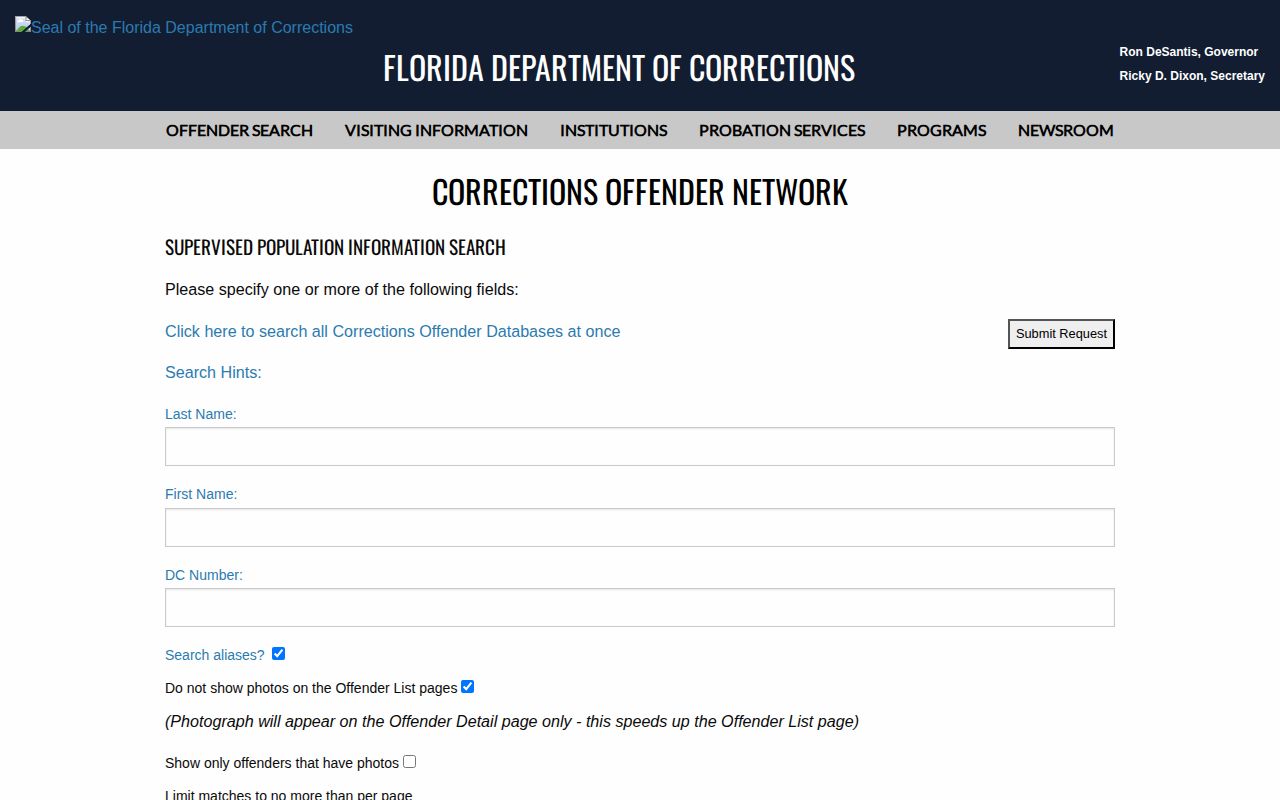
This form is the state-supervision entry point. It should not be used as a substitute for a St. Johns County court order or county-probation record.
St. Johns Supervision Office
FDC Circuit 7 serves Flagler, Putnam, St. Johns, and Volusia Counties. Its local entry is Office 074 in St. Augustine. The office can clarify an assignment or reporting location after the public record has been checked. It should not be assumed to hold every case tied to a St. Johns conviction. A person may reside in another county, move between offices, or report through a different unit.
FDC Office 074, St. AugustineLightner Museum Building
75 King Street, Suite 310
St. Augustine, FL 32084-4377
Phone: 904-825-5038
Fax: 904-825-6804
Use the FDC Circuit 7 office list to verify the current listing before a visit. Circuit administration is in DeLand and can help route a case when the listed local assignment is unclear. Record-specific instructions come from FDC and the court, not from the county jail roster.
St. Johns Absconder Status
FDC defines an absconder or fugitive as a person who has stopped making themselves available for supervision. The Absconder/Fugitive search is separate from the supervised-population search and can include a warrant-as-of date. A match means the supervision issue remains active. It does not show that the person completed probation, parole, or another term.
Compare the DC number, name, photograph when available, and status fields. Do not rely on a name alone. A warrant date is also a dated system statement, not a full account of the case. Questions about a match should go to FDC or the court. Do not approach a person based on a public listing.
The official FDC absconder page displays the special fields used for this narrower search.
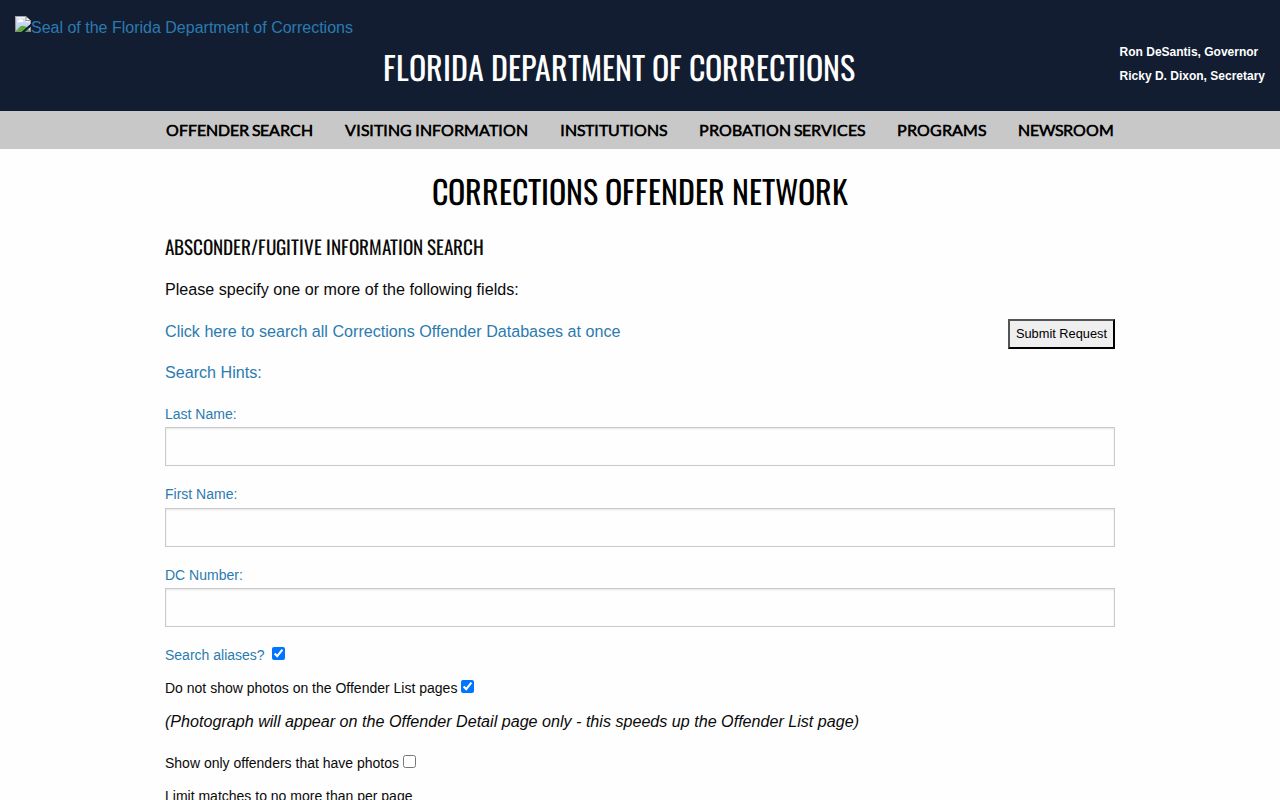
The separate page helps prevent a serious error: an absconder record is an unresolved supervision status, not evidence of a completed release or discharge.
Note: A missing absconder result does not prove that no warrant or court action exists in another system.
St. Johns Parole Hearings
FCOR, not FDC, makes parole decisions. Its commission voting schedule lists upcoming voting, conditional medical release, and follow-up dates. The calendar changes, so the live schedule controls. Hearing notices may include in-person, video, or telephone access. Credentials can change for each meeting.
A dated FCOR agenda may list a person's name, DC number, category, panel, county, offense, and case number. It is an agenda, not a result. No separate current public decisions search was identified in FCOR navigation during the research. To verify the outcome, check the later FDC record and request the vote, written order, or minutes through FCOR Public Records. Use the terms in the actual order because a presumptive date, an effective date, and a completed release are not the same event.
The official FCOR calendar shows the rolling meeting schedule rather than case outcomes.
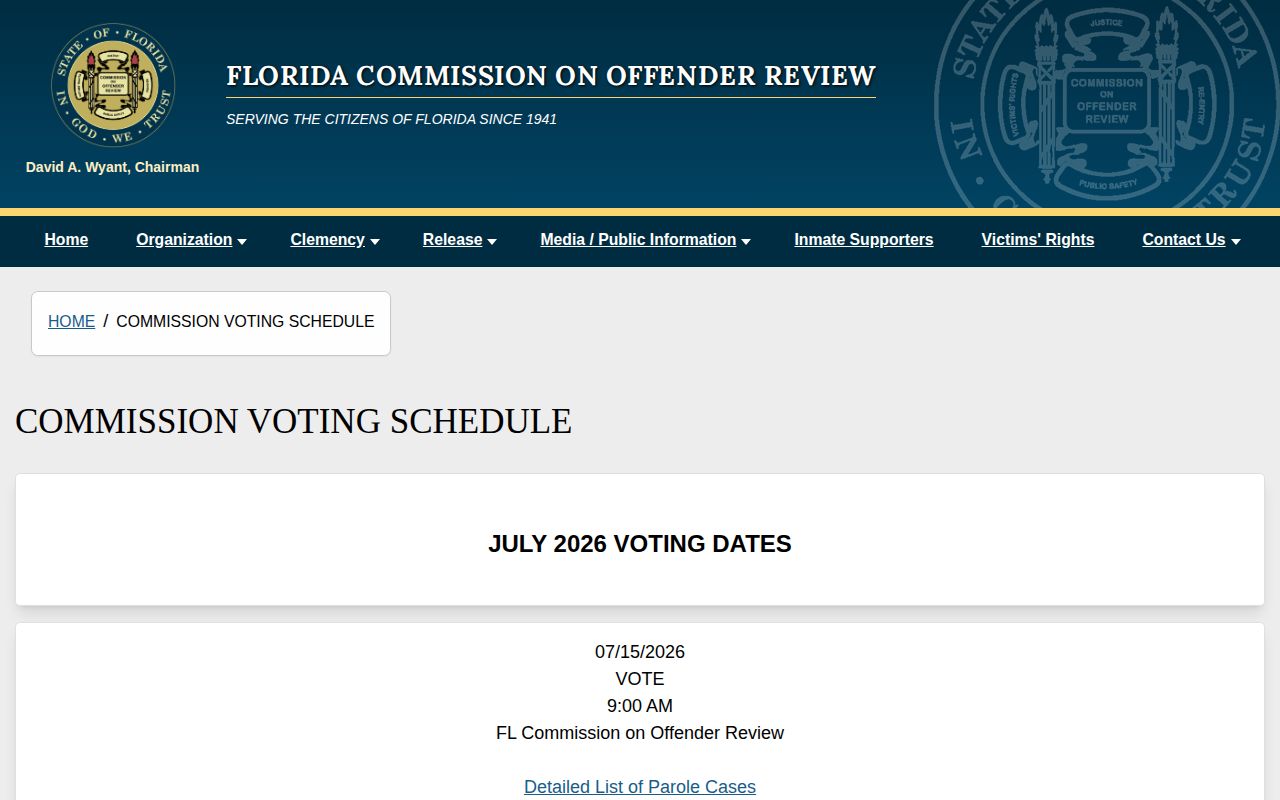
This schedule can identify when a matter was set for review. It cannot establish how the commission voted.
St. Johns Re-Entry After Release
SJSO reported opening an on-site Re-Entry Center in 2023 after renovating a building connected to the main jail. The annual report lists 369 assessments, 135 identification cards, and 93 family or support reunifications for that reporting period. Those figures describe program work. They are not St. Johns County release totals and should not be used to estimate how many people left custody.
Re-entry help and legal supervision serve different roles. Program help may address identity papers or family contact, while an FDC officer enforces the terms of probation, parole, conditional release, or community control. Participation in a support program does not prove a person is supervised. In the same way, an active supervision record does not reveal which local services a person used.
St. Johns Property After Release
The SJSO inmate handbook says property is returned at physical release after signed verification. County-issued items must be returned, and the person needs the facility identification card. The handbook lists a $6.28 replacement charge for a lost or damaged facility ID. This property process is tied to leaving SJSO custody, not to the length or type of later probation or parole.
Former inmates may also retrieve their own SmartJailMail photos, messages, and scanned mail without charge for up to 30 days after release. That short window is distinct from an FDC reporting deadline. The released person should follow the jail's property and account instructions while also following each condition in the court or supervision order. For physical property questions, SJSO lists 904-209-1430 on weekdays from 8 a.m. to 4:30 p.m. and advises callers to check before arriving.
Note: Jail property return confirms a custody step; it does not show that probation, parole, or another hold has ended.
St. Johns Supervision Discharge
Supervision ends through the controlling legal process. The FDC record may show a termination date or status, while the Clerk record can contain the court's termination or modification order. For parole, the FCOR order and later FDC status give the clearest public sequence. A scheduled end date should not be treated as completed until the record reflects that the term ended and no later action altered it.
Florida VINE can send custody or status alerts, but it is not a certified discharge record. The same caution applies to a missing jail roster entry. A released person normally leaves the current SJSO roster, yet that says nothing by itself about probation, parole, another agency's custody, or a later warrant. Confirm each layer with the office that owns it.