
St. Johns Projected Release Basics
A projected or tentative release date is a calculation for a future custody event. It is not proof that release occurred. Florida law uses the term tentative release date for a term-of-years state prisoner after FDC applies eligible gain-time to the maximum sentence expiration date. A past prison release date on a released FDC record answers a different question. It can show that state-prison custody ended, though the person may still have supervision or another hold.
St. Johns County jail cases do not all have computed dates. A person held before trial may leave on bond, by court order, after a dismissal, or after another case event. The timing can remain unknown until the legal condition is met and the jail finishes processing. Someone serving a county sentence may have sentence credit and locally maintained good-conduct calculations. Those are not found by applying the state-prison formula to the county jail term.
Scheduled versus actual: A future tentative date is an estimate. A completed release requires a past release entry or the official county release record.
| Status | What it means | Best confirmation |
|---|---|---|
| Pretrial detention | No fixed sentence-release date | Court docket, bond status, and SJSO Booking |
| County sentence | Local term with lawful jail and good-conduct credits | SJSO maintained calculation and Clerk sentence |
| State tentative date | FDC's current projection for prison custody | FDC detail and Bureau of Admission and Release |
| Past release date | Recorded end of that custodian's confinement | Released FDC record or SJSO release report |
Find St. Johns Projected Release
First identify where the person is held. SJSO operates the county Main Detention Unit and Community Work Release Center. FDC holds people sentenced to Florida state prison. A federal sentence uses the federal system, and an immigration transfer uses ICE. A date from one system cannot be assumed to end custody in another.
- Check the St. Johns County court case for the charge, sentence, jail credit, bond order, and later orders. A court date is not itself a jail release timestamp.
- For a state prisoner, open the FDC Inmate Release Information Search. Search by the six-digit DC number when known, or use first and last name.
- Open the matching record and compare several identifiers. Copy the date and FDC descriptor exactly.
- Decide whether the displayed date is in the future or past. A future scheduled date has not happened.
- For a county sentence, ask SJSO Records for the maintained calculation or release record rather than substituting an FDC result.
- Confirm a state date with the FDC Bureau of Admission and Release at 850-488-9167 or dc.release@fdc.myflorida.com when the status is unclear.
FDC says state release dates and location changes update nightly. The broader inmate-population data refreshes on a different schedule. A last-minute court order, corrected credit, disciplinary action, or transfer can make an older view stale. A St. Johns County named-person search also needs the local release record when the person was held only by SJSO.
Note: A person listed in FDC's release search may be released already or only scheduled for a future release.
St. Johns FDC Release Fields
The FDC release search covers felony offenders sentenced to state prison or state supervision. It does not cover a St. Johns County jail sentence or county probation. The search form allows name and DC-number searches, aliases, photo controls, and a limit on returned matches. Names work as prefix searches, so a short entry can return longer names that begin with the same letters.
| Field | Type | How to read it |
|---|---|---|
| Last name | Text search | Prefix matching can produce several people |
| First name | Text search | Use with other identity facts |
| DC number | Six-digit identifier | Best public key for one FDC record |
| Search aliases | Checkbox | Broadens matching to recorded names |
| Photograph controls | Display filters | Do not treat a missing list image as a missing detail photo |
| Prison release date and descriptor | Result data | Read the label, date, and whether it is past or future together |
The official FDC release-search page shows these controls and warns that its scope is the state corrections system.
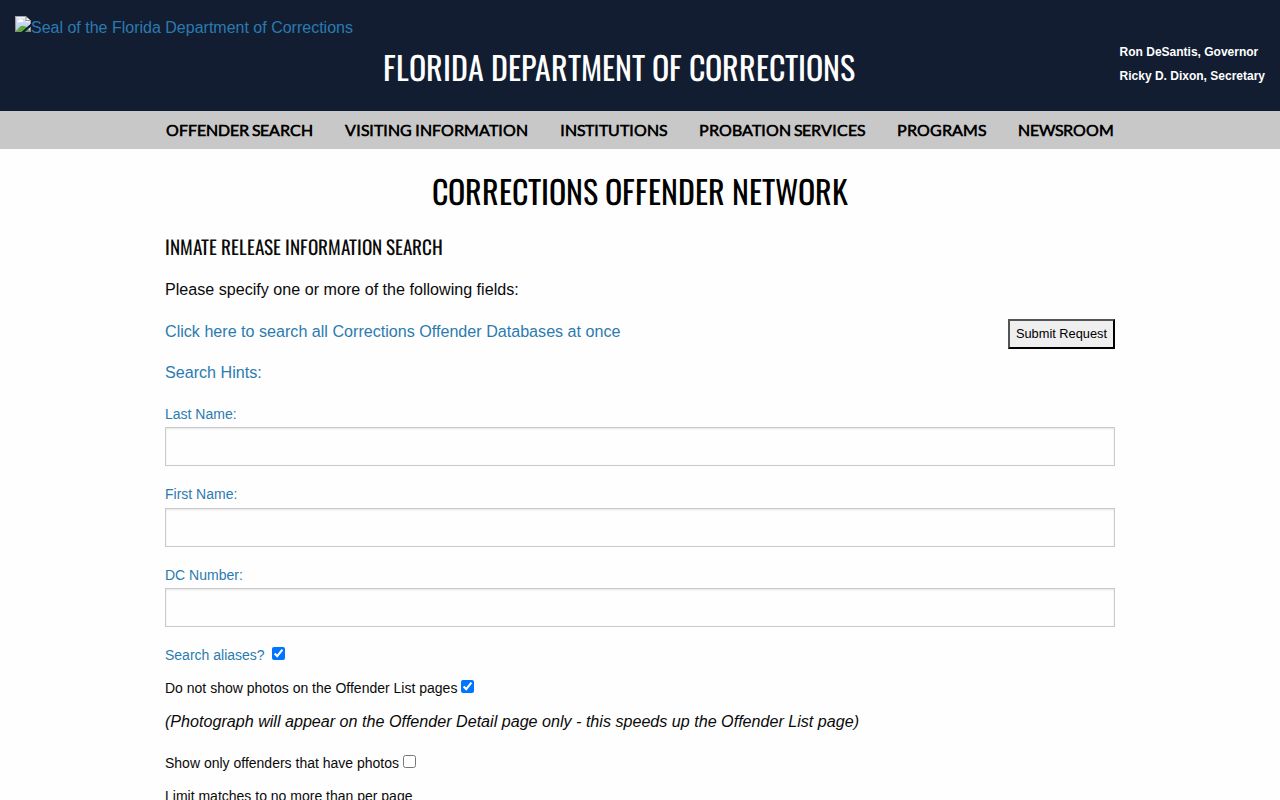
The screenshot is the search form, not a person's result. No tentative or completed date should be inferred from it.
St. Johns Historical Release Dates
FDC also publishes a public OBIS data export with separate files for active inmates, released inmates, and active offenders. The released-inmate root file covers state prisoners released since October 1, 1997. Related files can add aliases, past and current prison offenses, detainers, and incarceration history. The state says these downloads update monthly, usually near the first of the month, and exclude confidential, sealed, or expunged information.
The export can help when a recent web search no longer makes an older state release easy to locate. Its fields include the DC number, identity details, prison release date, and a release-date descriptor. Related supervision data may show a supervision type, location, status, or termination date. This remains a Florida state-prison archive. It is not a St. Johns County jail archive, and it cannot supply the actual release time or release type from an SJSO booking.
A historical state release date should be paired with the descriptor and custody record. A past date can confirm departure from FDC confinement, but it does not rule out later supervision, a new booking, federal custody, or an immigration hold. For a county case, the SJSO release report and Clerk disposition remain the local sources.
Note: Monthly archive data is useful for history, while the live FDC detail is the better source for a current projection.
Florida Tentative Release Calculation
Under Florida Statutes section 944.275, FDC first establishes the maximum sentence expiration date for a prisoner serving a term of years. That starting point reflects the imposed sentence or combined sentences and lawful credit for time physically held before sentencing. A later sentence, a corrected credit award, escape time, or a parole-violation period can change the calculation.
FDC then sets the tentative release date by applying gain-time that has been granted. Later awards or restored credit can move the date earlier. Forfeited gain-time can move it later. The tentative date cannot be later than the maximum expiration date. This process is why a copied date has a record date and a status. It is never a promise that the person will walk out on that day.
Offense date controls which gain-time law applies. The statute contains older basic gain-time rules and several incentive-rate periods. For offenses committed on or after October 1, 1995, eligible incentive gain-time may be awarded at up to ten days per month. The word may matters. The credit is earned and discretionary, exclusions apply, and no one should assume that every state prisoner receives the maximum.
The official gain-time statute shows the rules that support FDC's tentative date.
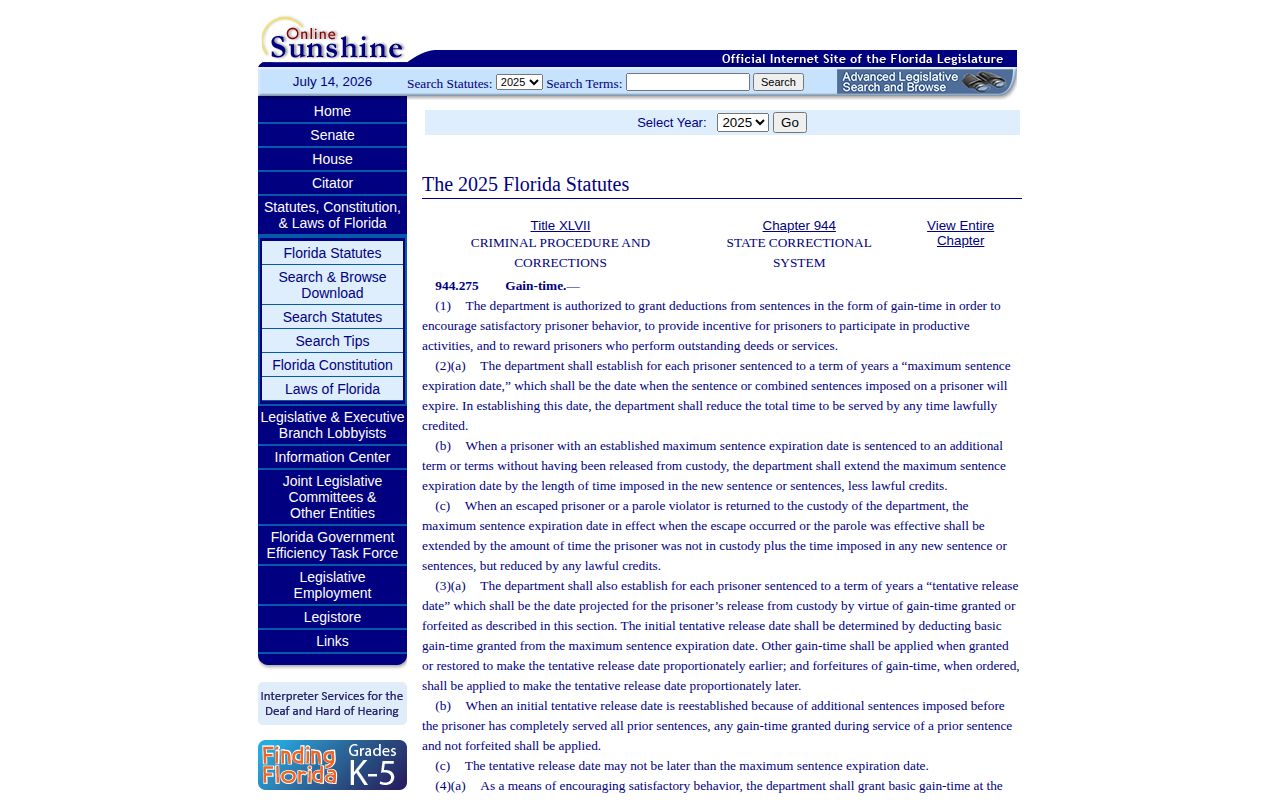
The statute supplies the legal framework. Only FDC's record-specific calculation can show the credit applied to one state sentence.
St. Johns 85 Percent Rule
For the post-October-1995 incentive regime, section 944.275 bars gain-time from producing release before the person serves at least 85 percent of the imposed sentence. Court-awarded credit for physical incarceration counts toward that floor. Once the tentative date reaches the 85-percent point, more gain-time cannot move it earlier. A life sentence remains natural life unless pardon or clemency changes it.
Section 921.002 reinforces the floor for Criminal Punishment Code sentences. It allows shortening only through lawful incentive or meritorious gain-time and says chapter 947 parole does not apply to those sentences. The percentage is not a general release-date calculator. It cannot be applied without the sentence, offense date, jail credit, mandatory terms, statutory eligibility, and FDC's maintained record.
Good-time limit: The 85-percent floor governs covered state sentences, not every county term, old offense, mandatory minimum, or life sentence.
Note: Eligible meritorious or educational awards can affect a state calculation, but exclusions and the statutory floor still control.
St. Johns County Jail Credit
County jail release calculations follow a different path. Florida Statutes section 951.21 authorizes county good-conduct commutation unless the county commission changes or discontinues the policy. The schedule can allow up to five days per month during the first and second years, with other tiers later, plus limited meritorious credit. Misconduct can cause credit to be lost.
The St. Johns County Community Work Release Center handles male county sentences of 364 days or less. As a result, later-year statutory tiers would not ordinarily describe the population SJSO says it houses there. More important, the statute is only authority. It is not proof of SJSO's present policy or the calculation in one person's record.
Use the Clerk's sentence, the actual jail credit, SJSO's maintained calculation, and the final release report. A bond release from the Main Detention Unit does not depend on FDC gain-time. Nor does a transfer from SJSO to FDC mean the person returned to the community. The sending and receiving records must be read together.
What Changes St. Johns Release Dates
A projected date can shift for legal and administrative reasons. Some changes come from sentence credit. Others come from a new order or another custodian's claim. The current record must identify which event applies. A generic estimate cannot account for each case.
| Change | Possible effect | Record to check |
|---|---|---|
| Gain-time award or restoration | May move an eligible FDC tentative date earlier | FDC sentence and release detail |
| Gain-time forfeiture | May move the date later | FDC calculation and disciplinary record |
| Corrected jail credit | Can recalculate the maximum or tentative date | Court order and custodian calculation |
| Additional sentence | Can extend confinement | Clerk docket and FDC detail |
| Detainer or hold | Can produce transfer instead of community release | Release destination and receiving agency |
| FCOR action | May set or alter a parole-related date in an eligible legacy case | Written FCOR order, not the agenda |
FCOR hearing agendas show matters set for review. They do not show the result. A presumptive parole release date, an effective parole date, and a physical release are also distinct. Verify the written order and later FDC status before describing the event as completed.
Confirm St. Johns Actual Release
For an SJSO release, request the maintained booking or release report with the actual date, time, release type, and transfer destination. The St. Johns County Clerk case can explain the court action, but a docket entry is not always the physical release time. For an FDC release, look for a past prison release date tied to a released record and then check whether state supervision continues.
Florida VINELink may provide a release or custody-change alert. It remains a status signal, not a certified discharge. The St. Johns VINELink inmate search explains the specific-person check and notification steps. If a local release appears to involve a transfer, search the receiving state, federal, or immigration system before saying the person is in the community.
Keep the key terms separate. Tentative means the date can change. Scheduled means an event is expected, not completed. Released means a named custodian ended confinement. Discharged can mean that custody or supervision formally ended, depending on the record. Those labels protect against turning a forecast into a false claim.